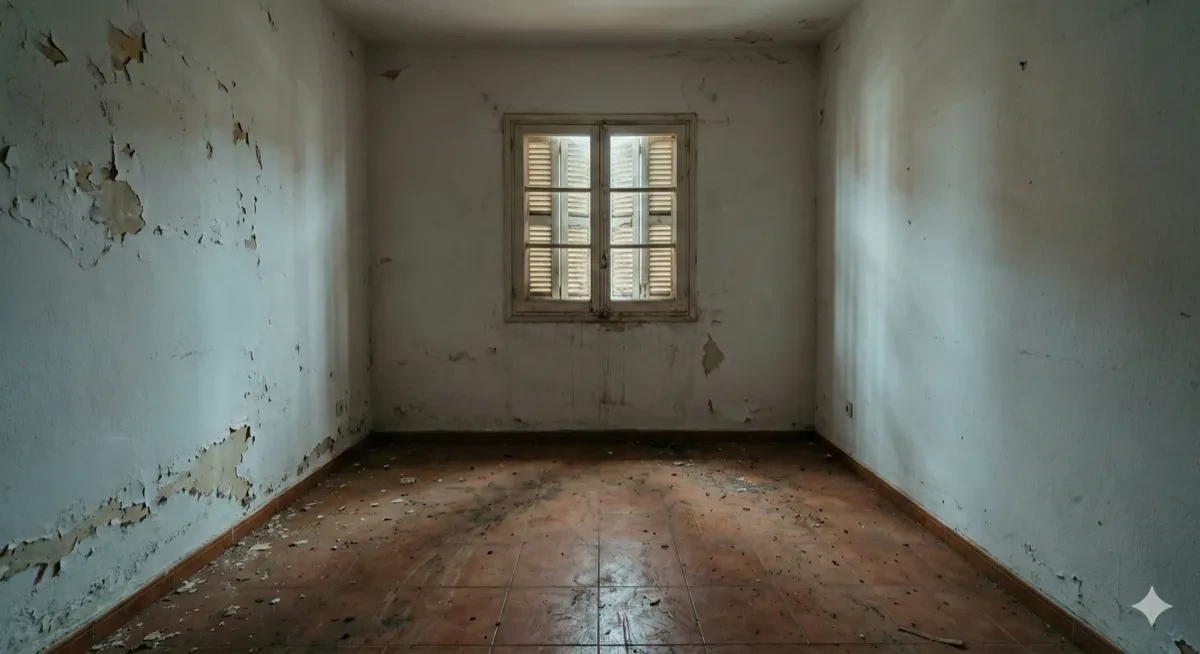
There are thousands of empty flats in the Canary Islands. According to data from the INE (Spain’s National Statistics Institute) and municipal electricity consumption records, an estimated 10% to 15% of dwellings in the archipelago are permanently unoccupied. They are not holiday second homes or flats undergoing renovation. They are properties that simply go unused.
Behind every empty flat there is a landlord with their reasons. Some are understandable. Others are based on fears that, when you put them on the table with real numbers, do not hold up. Because what many landlords have not calculated is how much not renting is costing them.
This article is about exactly that: the real numbers. How much an empty flat costs each month, how much income you are forgoing and what alternatives exist for those who want to make their property profitable without the headaches.
The fixed costs that never go away
An empty flat generates no income, but it does generate costs. Every month, without fail, these charges leave your bank account:
IBI (Impuesto sobre Bienes Inmuebles — local property tax)
IBI is mandatory regardless of whether the flat is occupied or empty. In the Canary Islands, the tax rate varies by municipality, but as a reference:
- In Las Palmas de Gran Canaria, an 80 m2 flat in an urban area pays between 400 and 800 euros per year in IBI.
- In Santa Cruz de Tenerife, similar figures, with variations depending on the neighbourhood and cadastral value.
- In smaller municipalities it may be somewhat less, but never zero.
Divided over twelve months, that is between 35 and 70 euros you pay every month for a flat that gives you nothing in return.
Furthermore, some Canarian councils have the power to apply a surcharge of up to 50% on IBI for dwellings that have been permanently unoccupied for more than two years. This measure, provided for in the 2023 Housing Act, is already being implemented in several Spanish municipalities and could extend to the Canary Islands.
Community fees
The community charge is always payable, whether someone lives in the flat or not. The building’s common expenses (lift maintenance, cleaning, communal electricity, concierge if applicable, building insurance) are shared among all owners according to their participation coefficient.
Monthly community fees in the Canary Islands range between 40 and 120 euros for a standard flat. If there are special levies for major works or extraordinary repairs, they can add several thousand euros more.
Home insurance
Having an empty flat without insurance is reckless. If a water leak damages the flat below, if there is an electrical fire, if someone breaks in and is injured — without insurance, you pay directly.
A basic home insurance policy for an empty flat costs between 150 and 300 euros per year. Note: many insurers apply surcharges or exclusions to unoccupied properties. If your flat has been empty for more than 30-60 consecutive days, check that your policy covers it.
Minimum utilities
Even if the flat is empty, you probably keep at least the electricity and water connected. The reason is practical: disconnecting and reconnecting utilities every time you need access to the flat (to show it, for a repair, for an inspection) is a bureaucratic hassle and has a cost.
Minimum utilities, just for keeping the contract active, amount to between 30 and 50 euros per month (contracted power for electricity plus the fixed water charge).
The total monthly cost of an empty flat
Let us add it all up for a standard two or three-bedroom flat in an urban area of the Canary Islands:
| Item | Monthly cost |
|---|---|
| IBI | 45-65 euros |
| Community fees | 50-100 euros |
| Home insurance | 15-25 euros |
| Minimum utilities | 30-50 euros |
| Total | 140-240 euros/month |
That is between 1,680 and 2,880 euros per year leaving your pocket for a property that gives you nothing in return. And we have not yet started talking about the cost that does not appear on any invoice.
Deterioration: the silent expense
An empty flat deteriorates faster than an occupied one. It seems counterintuitive, but it is a fact that any property professional will confirm.
Why an empty flat falls into disrepair
-
Humidity and ventilation: A closed-up flat accumulates moisture. In the Canary Islands, especially in coastal areas and at mid-altitude, ambient humidity is high. Without regular ventilation, damp patches appear, mould grows on walls, condensation forms on windows, and odours develop. Finishes deteriorate.
-
Unused installations: Pipes that go unused for months can become blocked by mineral deposits or develop corrosion. Traps dry out and allow odours and, in extreme cases, insects to enter. Boilers and water heaters accumulate sediment when not in use.
-
Pests: An empty flat is a perfect refuge for cockroaches, mice and, in the Canary Islands, wood moths. Without a regular human presence to spot the early signs, a minor pest problem can become a serious issue before you realise.
-
Aesthetic degradation: Paint yellows, bathroom silicone blackens, appliance seals dry out, shutters seize up. Every month of disuse is a step towards a refurbishment that will be more expensive the longer it is delayed.
Estimating the cost of deterioration in euros is difficult because it is cumulative and invisible until one day you open the door and face a renovation bill. As a rough guide: a flat that has been empty for two years typically needs an investment of between 3,000 and 8,000 euros to bring it back to market condition (painting, deep cleaning, plumbing repairs and minor fixes). An occupied and maintained flat over the same period would need a fraction of that investment.
Opportunity cost: the income you are missing
So far we have discussed what you spend. But the real cost of an empty flat also includes the income you fail to receive.
Let us do a simple calculation with a two-bedroom flat in Las Palmas de Gran Canaria or Santa Cruz de Tenerife:
- Long-term whole-flat rental: 900-1,200 euros/month.
- Room-by-room rental: 1,200-1,800 euros/month (depending on the area and condition of the flat).
If we take a conservative value of 1,000 euros per month as potential rent (see how much you can really earn renting an apartment in the Canary Islands for more detailed figures), the annual opportunity cost of not renting is 12,000 euros.
Now let us add the opportunity cost to the fixed expenses:
| Item | Annual cost |
|---|---|
| Fixed costs of the empty flat | 1,680-2,880 euros |
| Income not received | 12,000 euros |
| Total real cost | 13,680-14,880 euros/year |
In other words: keeping a flat empty in the Canary Islands may be costing you between 1,140 and 1,240 euros every month. This is not a theoretical figure. It is money leaving your account and money not entering it.
Over five years, the accumulated cost exceeds 70,000 euros. If you add the deterioration of the property and the potential devaluation due to poor condition, the impact on your wealth is very significant.
Why landlords do not rent: the fears laid out
If the numbers are so clear, why are there so many empty flats? Because the decision to rent is not purely rational — it has a powerful emotional component. The most common fears we hear from Canarian landlords are:
“I’m afraid they won’t pay”
This is the number one fear and the most legitimate. Prolonged non-payment, combined with an eviction process that can take months, is a real nightmare. But it needs to be put in context: the percentage of tenants who stop paying in Spain is around 5-7% of all contracts. It is a risk, not a certainty. And there are tools to mitigate it: rent guarantee insurance, rigorous tenant selection, payment in advance, deposits and guarantors.
”They’ll wreck the flat”
The fear that a tenant will damage the property is understandable, but statistically rare when the tenant is well selected. A contract with a photographic inventory, an adequate deposit and home insurance with vandalism cover addresses the vast majority of scenarios. Moreover, as we have seen, an empty flat also deteriorates — just more slowly and with nobody to offset the cost.
”I don’t want hassle with tenants”
Managing a rental can be tedious: finding tenants, showing the flat, drafting contracts, fixing breakdowns, handling disputes. But this is not an argument against renting; it is an argument for delegating management to a professional.
”I might need it at some point”
If you genuinely plan to use the flat in the coming months, it makes sense to keep it available. But if you have been saying “I might need it” for over a year without actually needing it, you are paying an availability insurance that costs you more than a thousand euros a month.
”I don’t know where to start”
This is the easiest fear to resolve and, paradoxically, one of the most paralysing. The bureaucracy of renting — contracts, deposits, registration, taxation — can seem overwhelming from the outside. But it is a perfectly standardised process that a property professional resolves in days.
The real risk of an empty flat: illegal occupation
There is one risk of an empty flat that few landlords talk about until it happens to them: illegal occupation (squatting). A flat empty for months is a potential target. The signs of vacancy are obvious to those looking for them: overflowing letterbox, permanently lowered shutters, no sign of activity, minimal or disconnected utilities.
Once occupation occurs, the legal process to recover the property can be lengthy and costly, especially if the occupants claim social vulnerability. It is an extreme scenario, but not uncommon — and a rented flat, with tenants present and active utilities, simply is not a target.
How to turn an empty flat into a productive one
If you have read this far, you probably already see that the cost of not renting is too high. The next question is: how to do it in the way that creates the least friction for you?
Option 1: Rent it out yourself
You post a listing on Idealista, select a tenant, draft a contract and manage everything. It is the most profitable option in gross terms, but it requires time and knowledge. If you have both, it is a perfectly valid choice.
Option 2: Hire a traditional estate agency
An agency can help you find a tenant and draft the contract. They typically charge one month’s rent as commission. The problem is that their work usually ends there: once the contract is signed, day-to-day management is still your responsibility.
Option 3: Delegate full management with the rent-to-rent model
This is the option that eliminates all the fears in one stroke. In the rent-to-rent model, a professional company rents your flat directly, at a guaranteed fixed monthly price, and takes care of absolutely everything: preparation, tenant search and selection, contracts, maintenance, cleaning, incidents, collections.
You get paid every month regardless of occupancy. The risk of non-payment is zero because your contract is with the company, not with the end tenants. Your flat is professionally cared for and kept in good condition. And if you need to recover the property, the contract with the company has clear exit conditions agreed from the start.
It is not the option that maximises gross profitability — you can only achieve that by managing everything directly with maximum occupancy. But it is the option that maximises net returns adjusted for time, risk and peace of mind. For a landlord whose flat is empty because they do not want complications, it is exactly the solution they need.
The final numbers
Let us put the figures side by side for a two-bedroom flat in an urban area of the Canary Islands:
| Scenario | Monthly result |
|---|---|
| Empty flat | -180 euros (fixed costs) |
| Flat rented (long-term, self-managed) | +800-1,050 euros net |
| Flat rented (rent-to-rent, management delegated) | +600-900 euros net |
The difference between keeping the flat empty and having it rented with delegated management is between 780 and 1,080 euros per month. Per year, that is between 9,360 and 12,960 euros you are currently leaving on the table.
If you have an empty flat in the Canary Islands and want to explore your options, at Looping Rooms we provide no-obligation valuations. We will tell you exactly how much your property could generate and under what conditions, so you can decide based on information, not fear.
Do you own a property in the Canary Islands?
Let us manage it. Guaranteed rent, no worries.
Request information with no obligation.