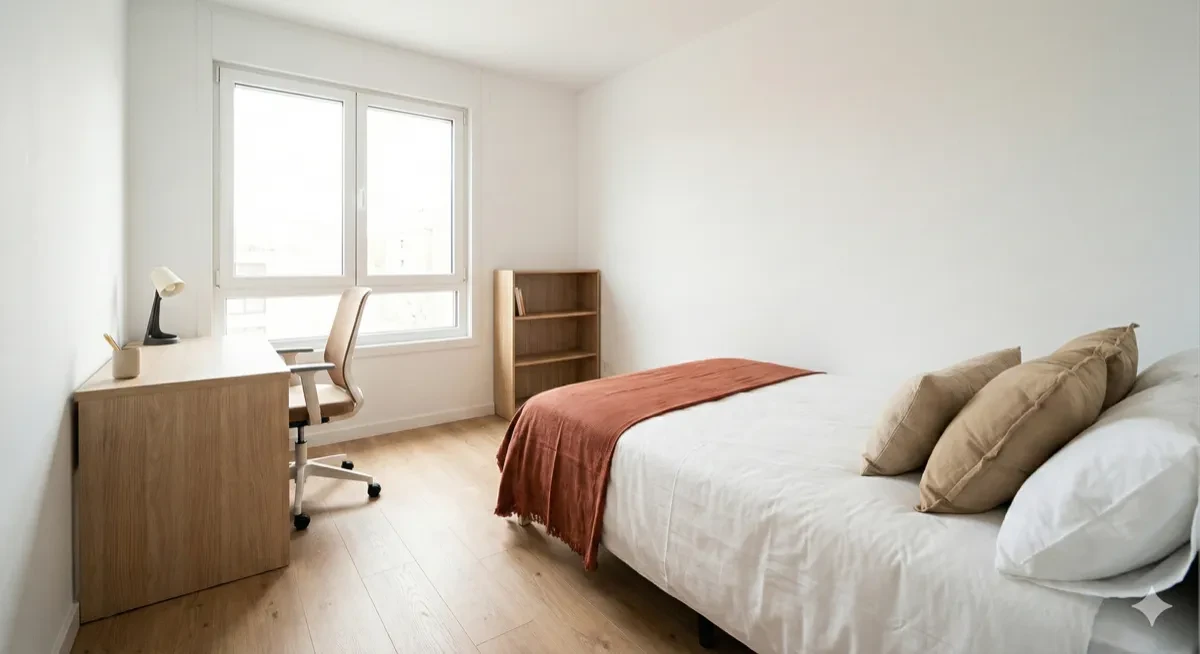
If you own an apartment with 3 or more bedrooms in the Canary Islands, you’ve probably asked yourself this question at some point: am I better off renting the whole place to a family, or renting each room separately? Both models have real advantages and drawbacks. Here’s a no-nonsense breakdown.
The fundamental difference
When you rent out the whole apartment, you sign a contract with a single tenant (or couple/family) who occupies the entire property. Your risk is concentrated: if that tenant stops paying, you lose 100% of your income.
When you rent room by room, you sign individual contracts with each tenant. Each room generates its own income. If one person leaves or stops paying, the other rooms keep producing. The risk is diversified.
Profitability: the numbers speak for themselves
The profitability of room-by-room rental is consistently higher — and the real numbers from the Canary Islands market in 2026 confirm it. The reason is simple: the sum of the individual rents for each room exceeds the rental price of the whole apartment.
A 3-bedroom apartment in Las Palmas that rents whole for 900 per month can generate between 1,200 and 1,500 per month when rented by the room (400-500 per room). That’s between 33% and 67% more gross income.
Why does this work? Because tenants looking for a room pay for the convenience: a furnished apartment, utilities included, contract flexibility, and the ability to move in without large deposits or multiple months of advance payment.
Tenant profiles
Whole apartment
- Families, stable couples
- Long-term contracts (1-5 years)
- Low turnover
- Looking for stability and independence
- Usually bring their own furniture
Room by room
- Young professionals, temporary workers, students, digital nomads
- Medium-stay contracts (3-12 months)
- Moderate turnover
- Looking for flexibility and services included
- Need a furnished, move-in-ready apartment
In the Canary Islands, the profile of room-by-room tenants has expanded enormously in recent years. It’s no longer just students — there are software developers, designers, medical residents, professionals on temporary assignments, and remote workers from all over Europe.
Management: this is the key difference
Room-by-room rental requires more management than renting the whole apartment. There are more contracts, more turnover, more coordination of shared living, and more maintenance due to the communal use of common areas.
If you manage the rooms yourself, expect to spend between 8 and 12 hours a month: posting listings, screening candidates, conducting viewings, drafting contracts, mediating flatmate conflicts, and coordinating cleaning.
This is where the rent-to-rent model makes all the difference. You delegate all the management to a professional company, collect a fixed guaranteed monthly rent, and don’t spend a single hour on it. The company takes on the full operation: finding tenants, maintenance, issues, cleaning, and rent collection.
Legal considerations
Room-by-room rental is governed by the Civil Code (not by the LAU, which covers primary residence rentals), giving the property owner greater contractual flexibility. If you want to explore this legal framework in depth, see our guide to room rental legislation in the Canary Islands. The mandatory 5-year extensions under the LAU don’t apply, and terms and conditions are freely negotiated.
It’s essential that each room has its own individual contract with a detailed inventory. And if you delegate to a company, the contract between owner and company can indeed be governed by the LAU as a non-residential lease.
In any case, always work with contracts reviewed by a legal professional. The cost of good legal advice is negligible compared to the problems it prevents.
Maintenance and wear
An apartment rented room by room experiences more intensive use than one rented to a family. More people using the kitchen, bathrooms, and common areas means more wear and tear.
However, a professionally managed apartment is maintained better than one managed by an amateur. Property management companies have periodic cleaning protocols, preventive maintenance inspections, and quick response to issues. The result: at the end of the contract, the apartment is usually in the same or better condition than when it started.
What type of apartments work best for each model?
Better for whole-apartment rental:
- 1-2 bedroom apartments where room-by-room management isn’t worthwhile
- Residential areas far from urban centres or universities
- Owners who want minimal involvement and don’t want to delegate
Better for room-by-room rental:
- Apartments with 3 or more bedrooms in urban areas
- Locations near universities, hospitals, or business centres
- Apartments in cities with digital nomad demand (Las Palmas, Santa Cruz, La Laguna)
- Owners looking to maximise profitability, especially if they delegate management
Conclusion
If you have a large apartment in a good area of the Canary Islands, room-by-room rental offers significantly higher profitability. The only real obstacle is the management — and that obstacle disappears if you delegate to a professional.
Want to know how much your apartment could earn with the room-by-room rental model? Request a free valuation and we’ll give you a concrete figure in less than 48 hours.
Do you own a property in the Canary Islands?
Let us manage it. Guaranteed rent, no worries.
Request information with no obligation.